
Tools and Techniques
We employ a diverse set of experimental and analytical techniques spanning neuroscience, developmental biology, cell biology, and genetics. Trainees in the lab learn a wide range of modern skills, positioning them as next-generation leaders in academia and industry.

2-photon microscopy
We use state-of-the-art voltage indicators, calcium indicators, and other fluorescent biosensors to monitor neural activity during sensory processing and behavior.
Visualizing the spread of localized synaptic input with genetically encoded voltage indicators. Video courtesy of Alex Hao and Sungmoo Lee.
Visualizing the spread of localized synaptic input with genetically encoded voltage indicators. Video courtesy of Alex Hao and Sungmoo Lee.
Sparse imaging
We have developed a tunable sparsening paradigm that accelerates experimental throughput, allowing us to rapidly screen for physiological phenotypes.
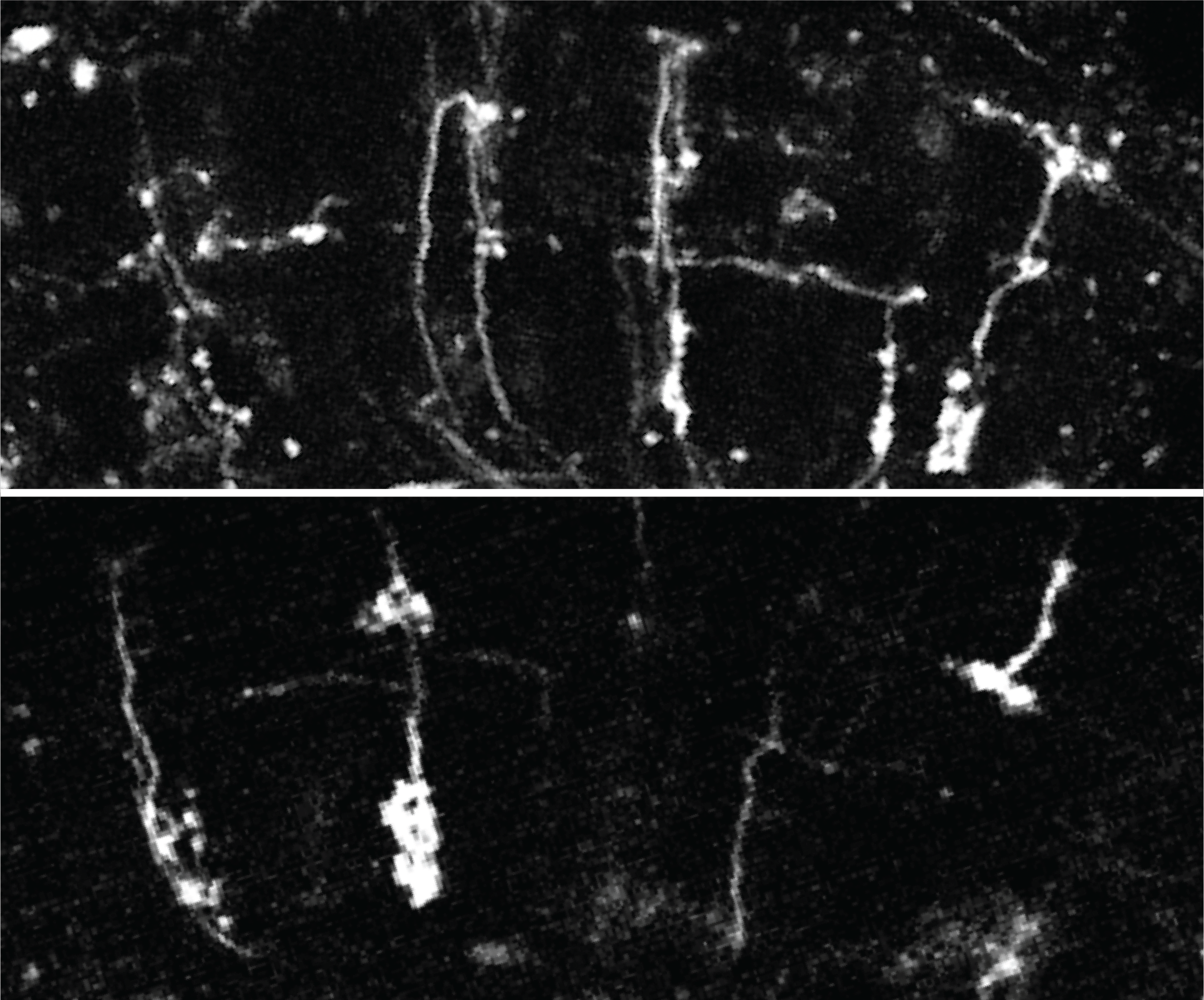
Tunable sparsening in the fly visual system. GCaMP expression density is tuned high in the top image and low in the bottom image.
Developmental physiology
We are piloting approaches to record from identified neurons in the pupal (developing) visual system, allowing us to study the developmental maturation of sensory computations.
Multiomic analysis
The fly visual system is a data-rich sandbox, allowing us to integrate over comprehensive resources to uncover the fundamental principles that shape neural computation.
Connectomics
We draw on a pair of complete wiring diagrams to understand how synaptic connectivity shapes circuit function.
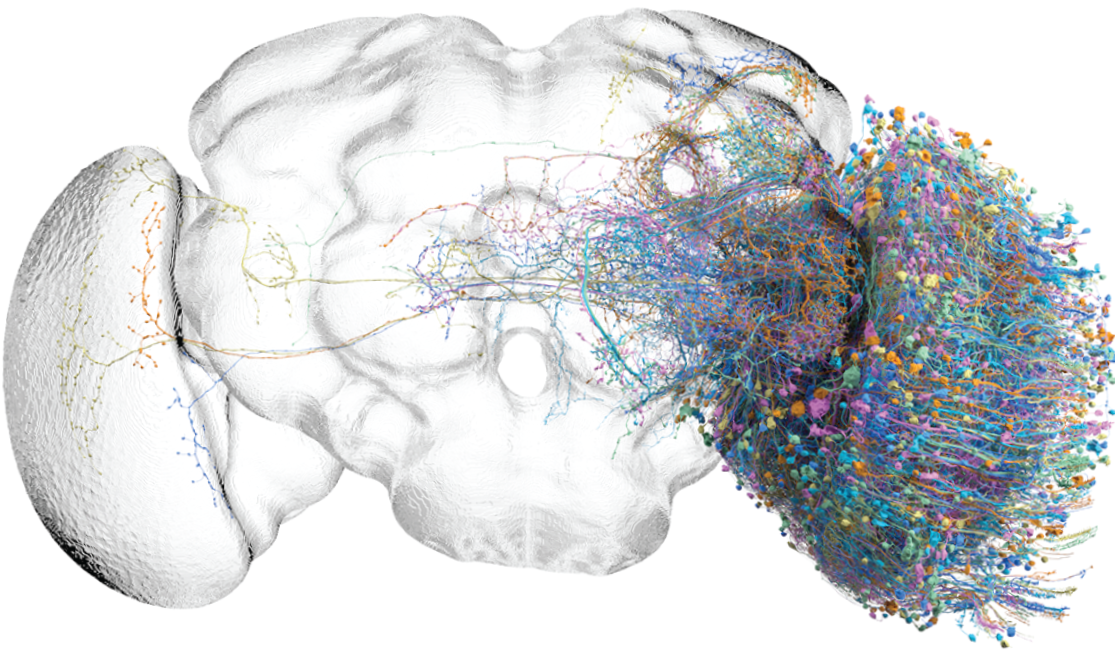
Optic lobe neurons in the male connectome, courtesy of the Reiser Lab.
High-quality longitudinal datasets from our collaborators allow us to identify fundamental relationships between gene expression, chromatin state, and functional diversity across neuronal cell types.
Transcriptomics & epigenomics
Neuronal manipulation
Drosophila research benefits from an extensive set of tools – from opto- and thermogenetics to expansive RNAi and overexpression libraries – that allow us to precisely manipulate identified cell types.
Behavioral tracking during optogenetic stimulation in freely walking flies using PiVR.
Quantitative behavior
Flies have a rich repertoire of vision-guided behaviors, providing a critical readout of physiological and developmental perturbations.
A tethered fly navigating in multisensory virtual reality.
Modeling
We use simple network simulations and behavioral models to generate new hypotheses and gain deeper mechanistic insights.
Genetic engineering
We combine the fly’s facile genetics and modern genome editing techniques to develop new tools for tackling longstanding questions.
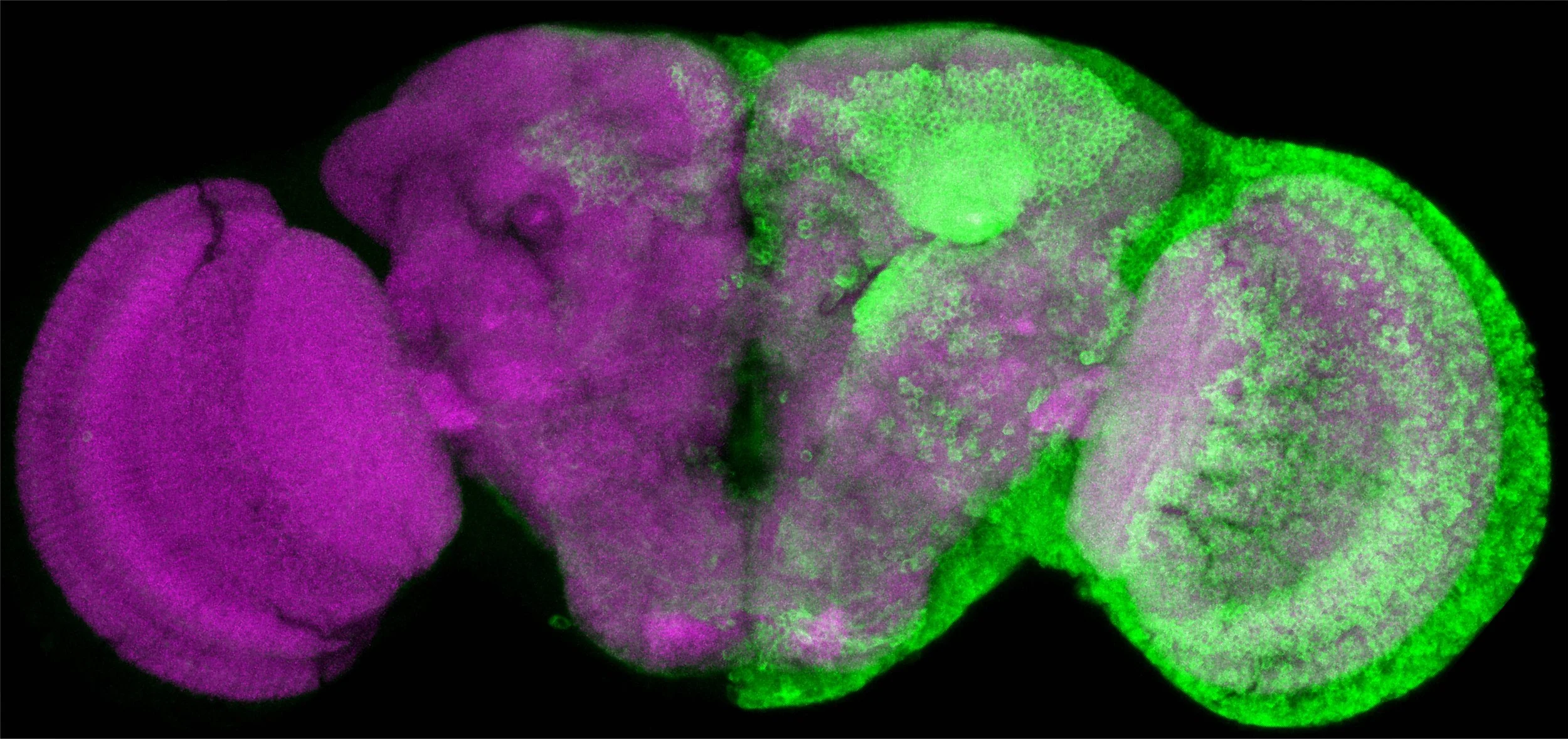
Unilateral control of gene expression with MCZR.