
How does a properly functioning brain put itself together?
The human brain contains billions of neurons that each perform precise computations on hundreds or thousands of synaptic inputs. This scale of computational diversity poses fundamental challenges during development – how does each immature neuron “know” which computations it needs to perform?
We leverage the fly’s unrivaled resources (and even create some of our own!) to ask how circuit-level computations are constructed during development. By uncovering the fundamental building blocks of computation in the brain, we hope to improve our models of what goes wrong in autism and other developmental disorders.

Current Projects
Ongoing work in the lab is aimed at understanding how gene expression, synaptic connectivity, and spontaneous network activity each contribute to computational diversity across neuronal cell types.
Is each neuron’s computational role pre-determined by developmental gene expression?
When a stem cell gives birth to a new neuron, the anatomical “identity” of that neuron is pre-specified by a code of genetic regulators – the transcription factor code. However, anatomical identity and physiological identity are not the same thing – for example, two neurons might look the same, but perform dramatically different computations. This raises the question of whether physiological identity might also be pre-specified by its own code. We hope to define such a code by drawing on existing datasets to identify correlations between developmental gene expression and mature physiology in the fly visual system. The results of this bioinformatic analysis will then guide manipulation studies, allowing us to directly link specific genetic regulators to different visual response properties.
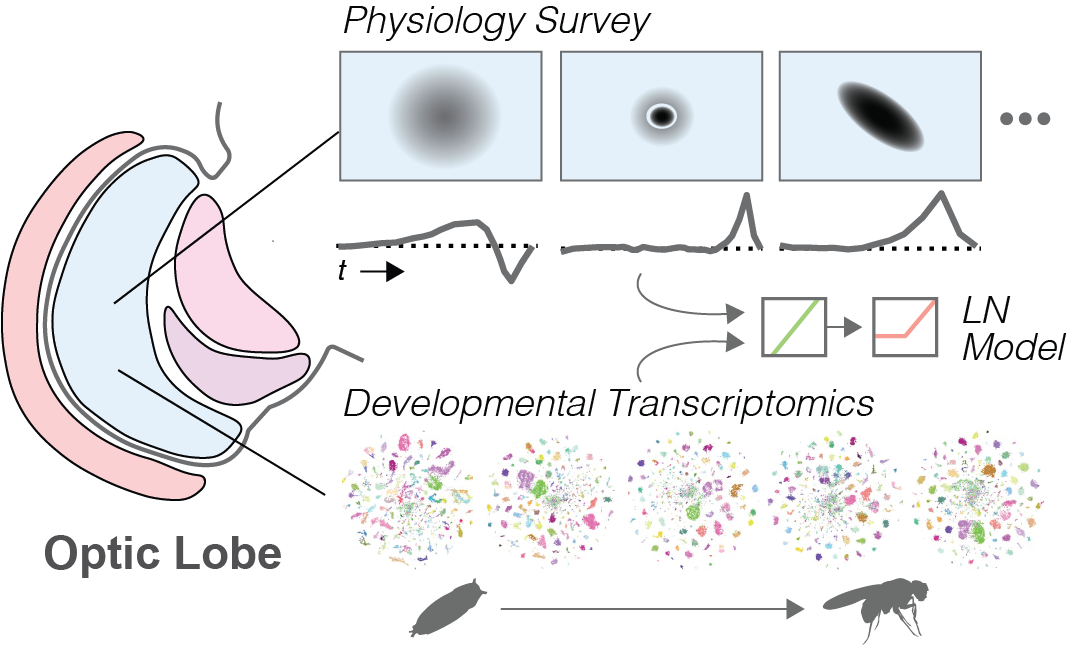
Integrating a large-scale physiology survey with developmental transcriptomics to identify a specification code for physiological identity.
Trainees working in this area will gain experience with multiomic analysis, 2-photon microscopy, sparse imaging, neuronal manipulation, and genetic engineering.
How is circuit function shaped by spontaneous network activity during development?
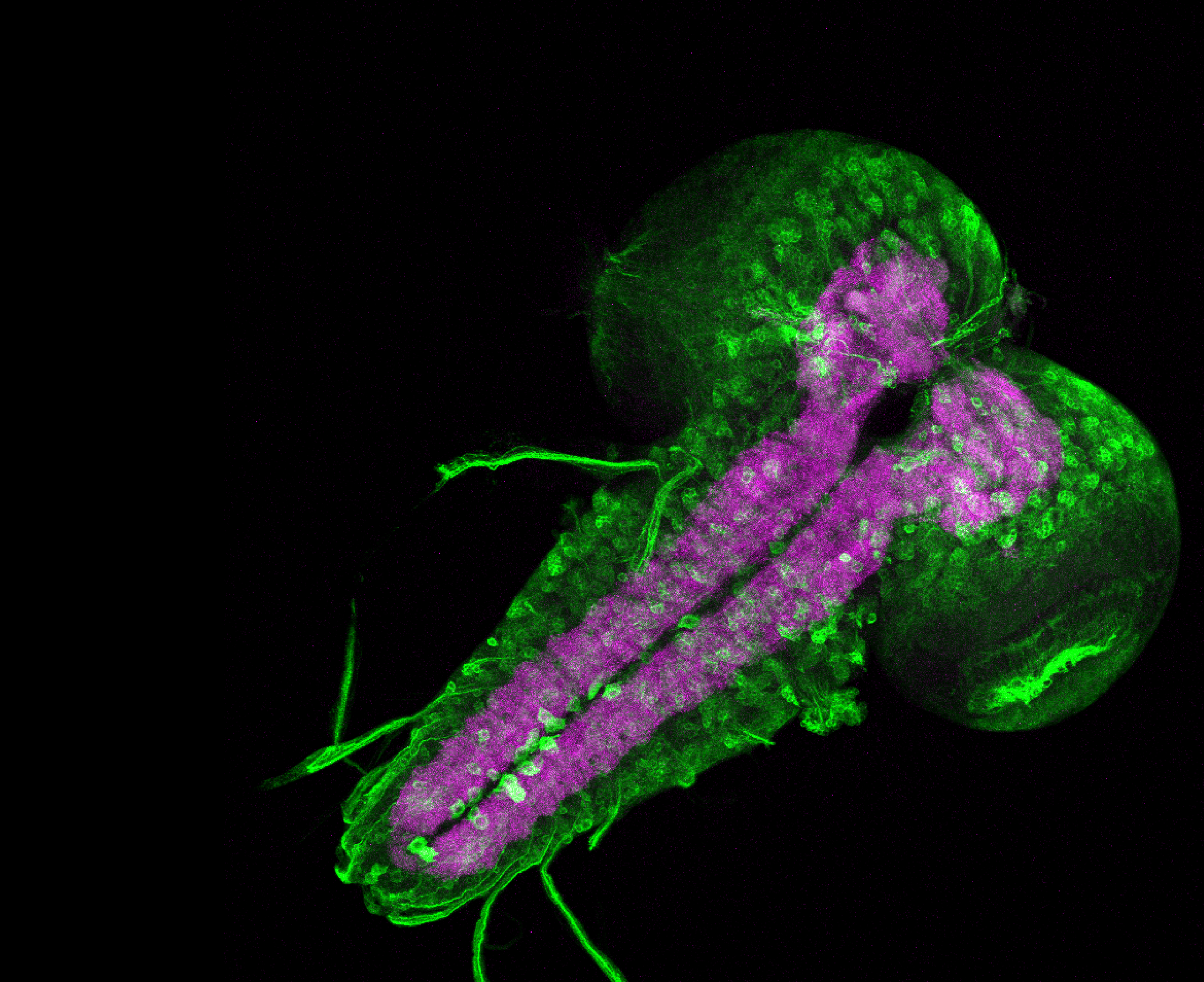
Developing brains across the animal kingdom spontaneously generate rhythmic waves of neuronal activity, even in the absence of sensory input. How does this activity shape mature circuit function? One possibility is that spontaneous activity is “testing” immature circuits and tweaking connection strengths, pushing the network towards some predefined computational target. Alternatively, spontaneous activity may be a necessary step for generating certain flavors of sensory selectivity. Together with our collaborators at UCLA, we are manipulating spontaneous activity in the fly visual system to probe the mechanisms that support innate circuit refinement.
Spontaneous activity in the developing visual system, courtesy of Orkun Akin.
Trainees working in this area will gain experience with 2-photon microscopy, developmental physiology, neuronal manipulation, computational modeling, connectomics, and genetic engineering.
How are complex visual representations built from simpler input signals?
Neurons in deeper layers of the visual processing pathway are known to encode more complex information with greater behavioral relevance. How are these signals generated? Without a full wiring diagram and a broad survey of upstream sensory activity, it has been difficult to decipher the mechanisms that combine simple inputs to build complex representations. Prior work from Tim and other groups have established these resources in the fly, allowing us to finally tackle some longstanding questions in this space.
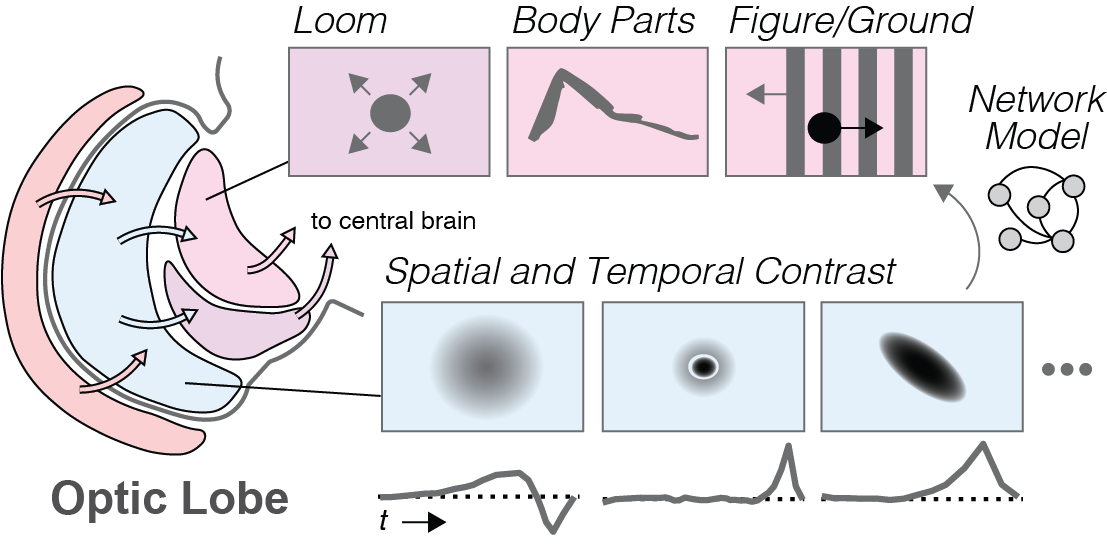
Representations of body parts and complex motion are only 1-3 synapses downstream of simple contrast-encoding neurons.
Trainees working in this area will gain experience with 2-photon microscopy, connectomics, computational modeling, neuronal manipulation, and quantitative behavior.